October 3, 2025
We had the opportunity to speak with Brad Scoggin, Co-founder and CEO of ArborXR, covering the company's origins, XR adoption challenges, the evolving XR ecosystem and, more. This interview has been edited for length and clarity.
Emily Sitnikova: Could you first give us a little background about yourself?
Brad Scoggin: Sure. I'm one of three founders at ArborXR, also the CEO, and originally from Oklahoma. I live in Southern California. I've got five kids. I went to University of Oklahoma and got a business degree, and then was actually in nonprofit work for seven years, which is a weird background for a tech founder. In 2016, I jumped into VR, so we’re right at about nine years and I’m going to milk it for the next two years and say we’re at 10 years in VR. We entered VR in location-based entertainment because we were excited for VR to make a difference in the world, and then were able to make the shift into enterprise in 2021.
Emily: Great. So, where does the name ArborXR come from?
Brad: It's funny, you would think more people would ask us that. First, you have to understand our vision: Part of that vision is we saw that VR has the power to change the world. We would love to see it change the world in a good way. I think there's a lot of potential for people to live in a VR headset in order to escape the real world, which doesn't feel healthy. We look at XR as a tool that we should use to increase the speed at which we train, learn, limit our travel, etc., so that we have more time to be present in the real world.
As for the name: An arbor is a wooden structure that supports the growth of a tree or vine or plant. There are a couple of ideas there, one being that we could be the structure behind the scenes, helping the industry grow in a healthy way. Also, an arbor is a peaceful place, typically found in a garden. Maybe you sit under the arbor and reflect or connect with a friend. That goes back to the ethos of VR giving us time to be present in the real world versus escaping from it.
Emily: I love that. So what are some key features of your solution?
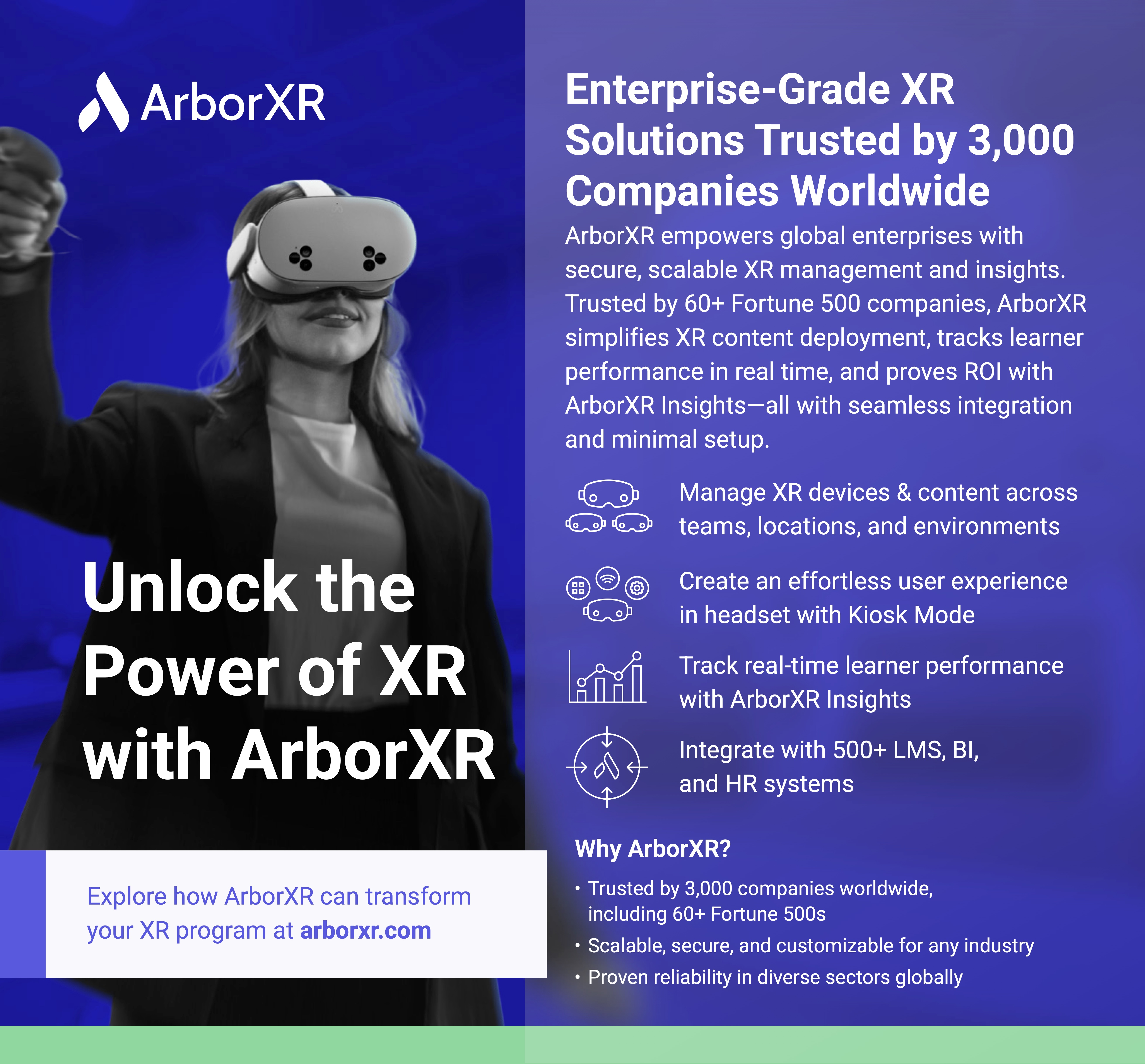
Brad Scoggin: Arbor is an MDM that's built specifically for XR. We solve four key pain points:
- Remotely configure and update the headset: So, you manage the device.
- Deploy large files and pieces of content: Customers can do version control, differential updating, etc.
- Control what happens inside the headset: There's a launcher allowing you to select what content the student or trainee can access.
- We actually acquired a company this year to add this key additional feature: We now allow companies to easily track ROI within the content and then pass that onto their existing LMS system.
I think the industry is now at a place of maturity where to get from POC to scale, it can't just be, “that seemed to go well." Leadership expects to be able to prove the ROI. We also found that you can look back historically, even just at other types of digital education. Right now in a large company, the virtual training is often siloed from the rest of the training. It doesn’t live inside the LMS, which is just another friction point for adoption. By offering pretty seamless LMS integration, companies can now bring their VR training inside the LMS alongside all the standard training they’re already doing.
Emily: You mentioned this is an MDM solution specifically for XR headsets. What are some MDM issues unique to XR and why are legacy MDMs not up to the task?
Brad: That's the crux, right? It’s the thing that surprises companies, especially IT departments. The VR champion gets excited because people learn faster, they retain more information, etc. in VR and then they go to IT and IT says, well, we already have an MDM, why do we need another one?
The surprise is that legacy MDMs just don't work well for a handful of reasons. Technically, for one, traditional UEMs are actually built to support Android Enterprise and XR devices are Android open source. But really, when it comes to the challenges of VR adoption in general, I like to think of it as death by a thousand cuts. It’s not any one friction point; it’s 12 or 24 friction points so people say, hey, this is really powerful but I just can’t mess with it.
Traditional UEMs are also not built to handle large file sizes or multiple versions. VR is primarily used as a training device. You’re pushing large content builds on a regular basis. So, one piece is the inability to see if the content is installed, what stage of installation it’s at, etc. Another piece is the inability to lock down what happens inside the headset. Traditional UEMs don't have really rich VR features, which makes the launcher that I mentioned earlier or the ability to do single sign-on for the headset really important.
Last and this may sound silly: The UI of these legacy MDMs is just so clunky and difficult to use. Oftentimes you've got to go through a full certification process to even use one of them. We built something that’s XR specific; it’s XR-first and simple to use. It has the core feature set you need to deploy XR at scale.
.png)
Emily: This follows and you touched on it, but is there a particular issue that tends to catch enterprises off guard?
Brad: They’re often surprised that their existing MDM doesn’t work for VR. That’s the drum we beat all the time: It sounds - and maybe at some level it is - self-serving because we’re trying to sell an XR MDM, but we’ve found, again and again, that you inevitably hit a roadblock unless you address this early on. You want to give leadership a good first impression. Even in a POC, you have to start with an XR-first MDM. You’re already bringing in new technology. You’re already working through change management by introducing a new modality for training. There’s already a lot of change happening. The parts that you can control, that you can make easy and seamless, you have to do that.
Emily: So, you’re in a good position to tell us this: Have you seen many large scale deployments of XR? What would you say to people who believe XR has failed in enterprise because of a lack of security or because of tension with IT?
Brad: First, yes, there are several very large deployments in the tens of thousands. We haven’t seen a hundred thousand devices deployed, but tens of thousands is significant. I would also say that on the whole, there’s a quiet adoption happening in the enterprise space. Enterprise is where XR is shining right now. This is where it’s having a moment because the core value prop isn’t about the technology necessarily or a cool new headset. It’s about, wow, people really learn faster. They have access to more information. You can train to de-ice a plane in your living room! I think that’s what’s propelling VR forward.
There's a handful of reasons some projects stall: 1) You didn’t get the MDM set up right. Again, I know it sounds self-serving but it’s a foundational piece. 2) You didn’t connect with the right ISV. You have to match the right content and the right content creator to the right use case. 3) The industry has matured to a point where you can’t move out of POC without real results. It's not enough to feel that trainees are more engaged; you have to prove that.
I don’t know that we’ve really seen projects fail. We’ve seen them get stuck in pilot purgatory, which is frustrating for everybody. We want to do everything we can to help people get out of that purgatory.
Emily: Right. You often have that one shot before management shuts it down. And it may take a few years before a new champion comes along and gets it revived. You mentioned acquiring a company. Can you dive further into the analytics part of the solution?
Brad: For sure. The why is just identifying that we’ve got to make it easy for companies and ISVs to measure ROI, to measure and track learner performance in a scalable way. It’s funny: In some ways, it’s very analogous to the early days of MDM and XR. Some of the very first few ISVs that got into XR training were building MDMs on their own out of necessity, and the same thing played out on the analytics side. Some of the early-mover ISVs were more successful because they realized that to get to the next level they had to have some way to track outcomes. For us, part of the vision is, let’s make that available to all ISVs, to all companies.
There’s two components to us: First, there’s the SDK, which is a few lines of code. You drop it in. It’s very quick. Everyone says two minutes and that allows you to annotate different activities or actions in the content. So you can go in and choose if it’s pass/fail, see if they turned the switch the right way…Whatever five or ten activities or actions you want to track. We’ve got a great dashboard to visualize that inside of Arbor.
The second component is the LMS or BI tool integration. You can have a passionate XR champion. He or she may have a small team and they’re seeing really powerful results, but the virtual training lives on its own island. That has been a barrier for ongoing adoption. For VR to grow, it really has to come into the fold of the rest of the organization’s training. That’s something we’re really proud of. Out of the gate we integrate with 500+ LMSs and it’s just a huge win for companies.
Emily: Again, given your position in the space, what is your advice for enterprises trying to choose from all the different XR hardware/software options on the market?
Brad: A handful of quick thoughts on that: For one, I think Android XR is a big deal. It may be a few years before we really feel the impact, but in the way that a year ago, Apple endorsed VR with the Apple Vision Pro...that was a huge stamp of approval with more devices to come. Google making the same endorsement is going to open up the world of VR in the coming years to all the traditional OEMs that are tried and true, that know how to deploy in enterprise and how to handle those sales cycles and procurement, etc.
With that said, I think back 7, 8, 9 years ago when we had tethered devices requiring multi-thousand-dollar gaming PCs that were impossible in education or enterprise. Today, we have a really high quality set of devices: Everyone knows it’s Meta, Pico, or HTC. They’re good headsets, each with their pros and cons, but there's a decent amount of variety to fit most use cases. We’re seeing an uptick in AR, too, so I think we’re in a good spot hardware-wise. For all the negative press, where would we be if Meta wasn’t investing like they’ve invested? They kind of took one on the chin for everybody else to push the tech forward.
On the content side, it’s a bit more tricky. It’s not just three choices but almost infinite choices. One of the early pain points we identified when talking to large companies is the amount of time they spend trying to find a trusted, high quality ISV. It’s hard. That’s a role we play in the ecosystem: We have a directory of content we’ve vetted, a list of ISVs we’ve worked with closely and witnessed deliver high quality content that produces high quality outcomes in the pilot. When we connect with a new customer, we do an assessment of their use case and help make connections.

Emily: Do you think that XR is out of reach of small businesses today? Do solutions like yours make it a little bit more accessible to enterprises of all sizes?
Brad: Well, I don't think it's out of reach because you can get a Meta headset pretty inexpensively and, again, there’s a lot of really good off-the-shelf content. I think our platform brings it all together and makes a seamless deployment possible for a small business or a classroom. We have customers of all sizes. In some cases, it’s annoying and frustrating because you want your business to grow faster. You want more people to have access to this really-life changing training content, but most of the time even the largest companies start with a small deployment to prove it and grow over time.
Emily: You described an ecosystem where you have all these ISV partners and you're also close to the headset companies. Can you describe that ecosystem and how you partner with other XR vendors?
Brad: I mean, I think the ecosystem approach is just necessary. Our perspective is that the ecosystem needs to be open so our platform is device agnostic. I think that's really important. A company should have the ability to choose whatever headset they want. Most of our customers actually have mixed fleets–-different headsets for different use cases. Same goes for software. As a startup in an emerging market, a closed ecosystem is tempting but the world has moved past that. We lean really heavily into the open ecosystem approach because you should be able to choose the best content, the best hardware, the best MDM for your use case. That’s been our goal.
And I think we've done a good job over the last few years of really becoming an expert in the ecosystem so that we can plug and play. We try to be self-aware in this way that each piece of the ecosystem does what they do best. You get into problems when you see an ISV wanting to be an MDM or a hardware company wanting to do content. We've always said, look, we'll stay in our lane, you stay in your lane and together we can win.
Emily: So last question, what's next for ArborXR?
Brad: That is a great question. I think we're just still so early. And when I say that, it's both encouraging and discouraging because it feels like we've been doing it for a long time. We need to step back occasionally and see the traction we’re seeing as an industry. In so many ways, we're just getting started. We talk about deployments in the tens of thousands and those exist, but there aren’t hundreds of those yet, right? We're talking maybe dozens globally but in those large deployments, we’re seeing powerful outcomes.
So for us, we just keep our heads down and keep doing what we're doing. We’ve all just got to remain patient and commit. It's making sure that all of us are building our companies for the long run. I don't know that there's going to be this hockey stick inflection point. I think it’s going to be this continual slow but steady growth, so we’re buckled up for the long haul and excited to see the growth year over year.